
A laboratory manager opens the inbox and sees the same question in several forms: Has this test started? When will it finish? Is the sample suitable? Have the test conditions been approved? Why is the result still outstanding?
None of those questions is unreasonable. The problem is that, on many geotechnical site investigation (SI) programmes, the laboratory becomes the reporting system. Every stakeholder needs visibility, but the current position has to be reconstructed through emails, spreadsheets and calls.
When status lives in the workflow rather than in the inbox, the question changes from “Can you update me?” to “What needs attention?”
Geotechnical Laboratory Status Tracking Without Status Chasing
Geotechnical laboratories already manage sample receipt, preparation, equipment, technicians, test conditions, quality checks and reporting. Repeated status requests add another stream of work that competes for the same people.
A single request may take only a few minutes. Across dozens or hundreds of active tests, however, the interruptions accumulate. Someone has to open the Laboratory Test Schedule (LTS), check the latest note, confirm whether a hold has been released and then write an answer that may be out of date a few hours later.
The burden also falls on asset developers, consultants and SI contractors, who often maintain parallel trackers simply so they can answer their own stakeholders.
Why weekly trackers do not solve a live-status problem
A weekly spreadsheet can be useful for formal reporting, but it is not a live operating picture. The moment a sample becomes unsuitable, an approval is granted or a test moves into progress, the static update starts to age.
That is why teams often keep asking the laboratory even when a tracker exists. They are not asking because there is no report; they are asking because they cannot see whether the report is still current.
Effective geotechnical laboratory status tracking should therefore show the present workflow state and the reason behind it, not merely a date copied into another file.
Give stakeholders visibility without giving up control
The answer is not to copy every stakeholder into every laboratory conversation. Different parties need different levels of detail, and project governance still matters.
With role-based access, asset owners, SI contractors, consultants and laboratories can view the information relevant to them while responsibilities remain clear. A client can see progress without changing laboratory data. A reviewer can see an approval awaiting action. The laboratory can manage the work without producing a bespoke status reply each time.
This is particularly valuable on multi-laboratory programmes, where status otherwise has to be normalised manually across several organisations.
How LabHarmony turns status into part of the workflow
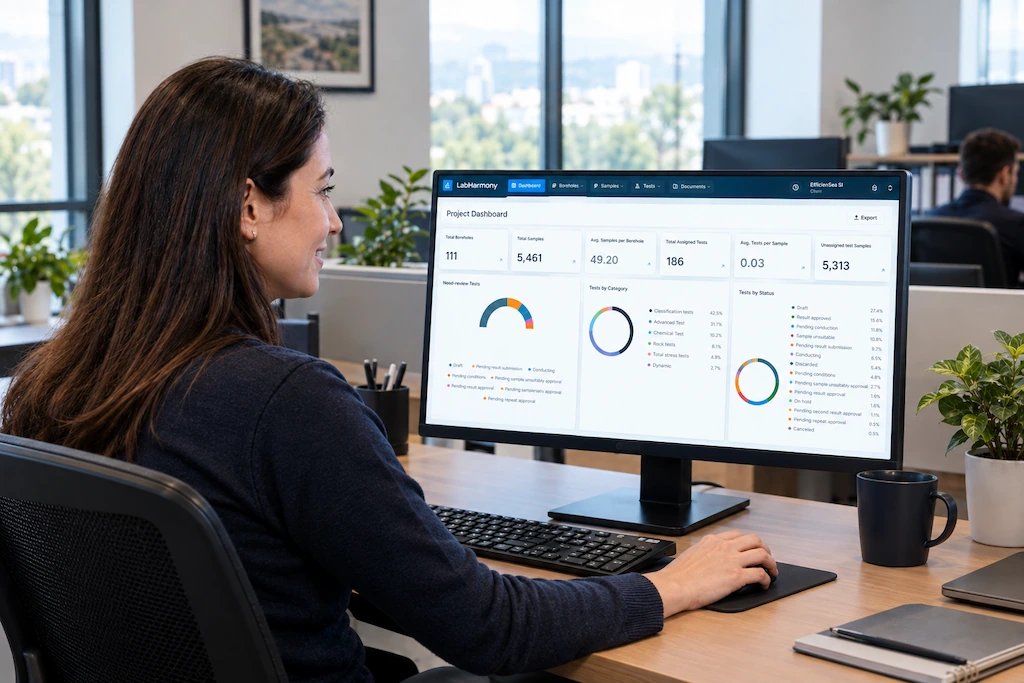
LabHarmony keeps samples, assigned tests, test conditions, approvals, progress, results, comments and cost information in the same project environment. Permitted users can see the current position directly from the live workflow.
The dashboard provides programme-level visibility, while the underlying sample or test record explains the detail. Full chain of custody, revision history and audit information remain connected to the operational record rather than being held in separate trackers.
The objective is not more reporting. It is to make routine reporting unnecessary when the information is already visible.
Customer perspective
One European transmission system operator reported that visibility of workflows and approvals in one system significantly reduced the interaction required between contractor, employer and laboratory, while improving transparency between the parties.
That is an important distinction: better transparency does not have to mean more meetings and more reporting. When the project can see the workflow, transparency can reduce the coordination burden.
Make the laboratory the testing engine, not the status helpdesk
The laboratory should spend its specialist time planning and delivering tests, not repeatedly reconstructing information that the project could already see.
If your project still depends on “Can you send me the latest status?” emails, the workflow is carrying information inefficiently. Live status gives every permitted stakeholder a common starting point and allows human attention to move to exceptions, decisions and technical judgement.
See how LabHarmony provides real-time laboratory visibility across the testing programme. Request a free LabHarmony demo.