
Midweek on a site investigation (SI) programme, someone asks a question that should be easy. Is this sample unsuitable for testing, and who decided that?
The answer often lives nowhere useful, perhaps it was mentioned by a lab technician the other day? Or maybe it was buried in an email form the contractor. Often “Chinese whispers” are being relied on to discover key project information. The sample sits on hold, or continues using the wrong parameters or assumptions. The decision itself has no clear owner, no approval record, and no trail anyone can open later.
That is still normal on many geotechnical site investigation jobs. It does not have to be.
How Unsuitable Samples in Geotechnical Laboratory Testing Are Handled Without a Shared Workflow
On a typical site investigation lab programme, samples move from borehole logging into laboratory work: arrival, assignment, test conditions, conduction, results and QA/QC. Somewhere in that journey, a sample can become unsuitable. It might be damaged, out of specification, the wrong material, insufficient mass, or otherwise not fit for the contracted test.
Without a unified platform, that moment tends to scatter:
- Discovery happens on the sample preparation bench, in a verbal update, or in an email that never reaches every stakeholder.
- Decisions land as “we’ll skip this one,” “hold it,” or “mark it unsuitable” often without a formal confirm/reject path.
- Approvals stay informal: a nod on a call, an “OK” in reply-all, a note that never gets filed against the sample.
- Status for the rest of the programme stays fuzzy. Developers and consultants still ask whether testing can proceed while contractors rebuild the picture from inboxes and spreadsheets.
- Later review means reconstructing memory: when did the sample become unsuitable, who flagged it, who agreed, and what replaced it on the schedule?
Excel trackers and SharePoint folders can store a status column but they cannot enforce an approvals path with clear updates, or leave a reliable actions trail when the question returns months later.
Where Traditional Geotechnical Laboratory Workflows Break Down
The tools people recognise (email chains, spreadsheet status sheets, SharePoint drops, Media Shuttle transfers) were built for files and messages, not for a live sample decision.
That creates four familiar failures:
- No real-time visibility: unsuitable status reaches some parties late, or only after a chase.
- Fragmented workflow: the flag lives in chat; the schedule lives in Excel; the rationale lives in someone’s head.
- No single source of truth: one person’s “unsuitable” is another person’s “still pending.”
- Poor traceability: when a dispute or audit asks when and who, the inbox is not an audit trail.
Unsuitable samples are not rare edge cases; they are a normal part of geotechnical laboratory work. The risk is not that they happen, it that they are not dealt with in an open and transparent way.
How LabHarmony Helps Manage Unsuitable Samples
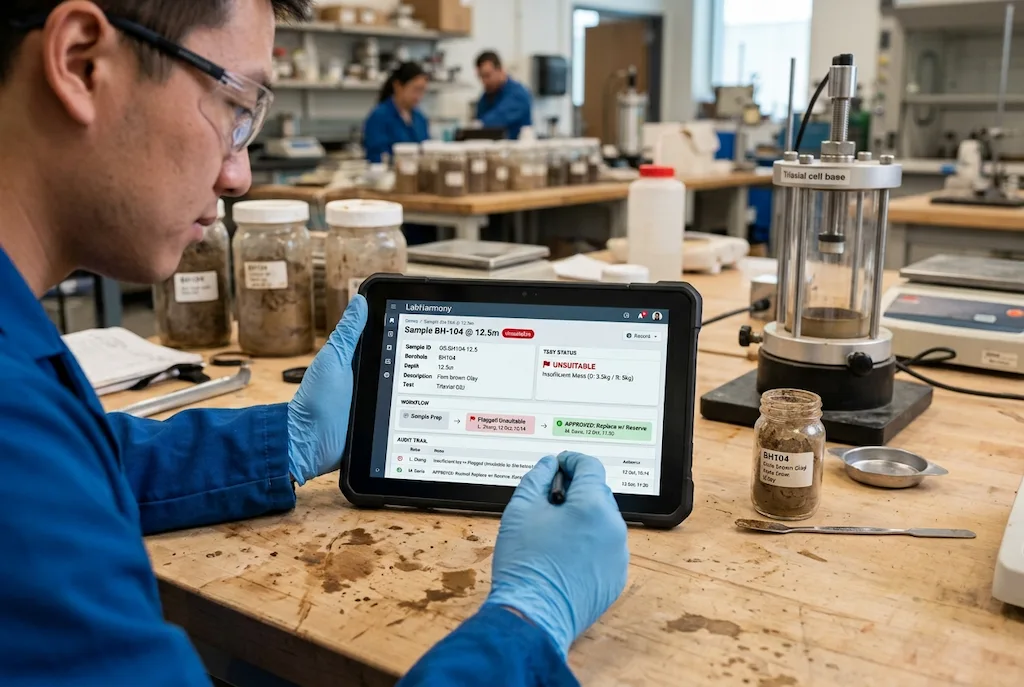
LabHarmony keeps the same site investigation laboratory journey , sample retrieval, test assignment, specifying conditions, conduction, producing results and QA/QC. This process is in one place for developers, contractors, laboratories, and consultants.
When a sample cannot proceed, the product path is explicit:
- Flag the sample as unsuitable in the workflow.
- Record the approval follows a recorded path and permitted roles see the decision and confirm it, rather than relying on a verbal OK.
- Maintain an audit trail remains available: who flagged, who approved, and when, as time-stamped actions on the shared project.
- Track sample and test status
Live sample and test status sit alongside that decision, so stakeholders do not need a separate chase to learn that a sample is on hold or unsuitable. Chain of custody and action history support later questions without reconstructing an email thread.
Who Benefits from a Shared Unsuitable Sample Workflow in Site Investigation?
| Role | What changes |
| Laboratories | Clear place to flag unsuitable samples, there is less chasing for informal sign off |
| SI contractors | Shared status when samples cannot proceed, with fewer “what happened to sample X?” emails |
| Consultants | Traceable decisions when reviewing programme impact or disputes |
| Infrastructure developers / clients | Visibility into holds and unsuitable outcomes without waiting for a weekly rebuild |
Nobody needs another status meeting just to learn that a sample was marked unsuitable last Tuesday.
See How LabHarmony Manages Unsuitable Samples
If unsuitable samples in your geotechnical laboratory still live in calls and inboxes, chats, and memory on your site investigation programmes, see how flag → approval → audit works in LabHarmony.
Request a free demo