
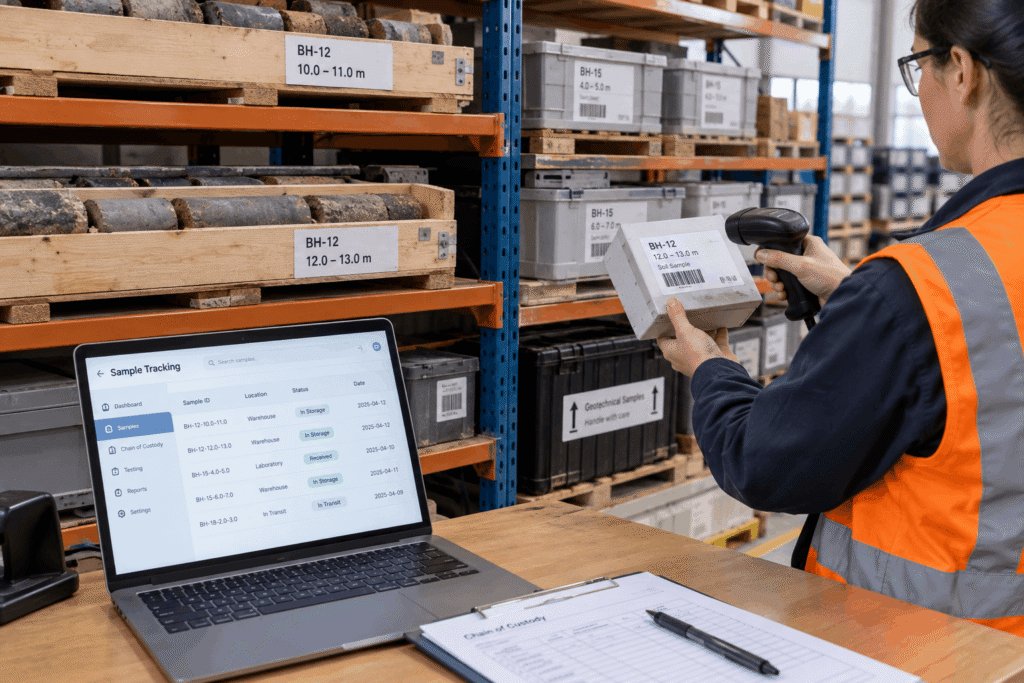
A sample leaves the vessel, drilling site or storage facility.
A few days later, someone asks: “Has the sample arrived at the laboratory?”
For geotechnical laboratories, this simple question is at the heart of effective geotechnical sample tracking.
It sounds like a simple question. But answering it can mean several steps: checking a chain-of-custody form, searching an email thread, opening a sample tracker, looking through a SharePoint folder, or calling the laboratory. Even after all of that, the answer can still be unclear.
The problem is not the movement of the sample itself. The problem is that different parties often record the movement across several disconnected places.
Why geotechnical sample arrival matters
For a laboratory, receiving a sample is not simply a logistics event. It can determine when testing can begin.
Someone may already have assigned a test. Equipment may have been provisionally scheduled. Technicians may be expecting the material. Test conditions may already be under preparation. But if nobody can clearly see whether the sample has arrived, the laboratory cannot plan the next step with confidence.
The same uncertainty affects the wider project. The SI contractor may believe someone has dispatched the sample. The laboratory may not yet have received it. The consultant may be waiting for testing to begin. The client simply sees that the programme has stopped moving.
One sample-status question can therefore involve several organizations. “It was dispatched” is not the same as “it was received”.
This distinction becomes particularly important on larger programmes. Samples may move in batches. Different boxes may arrive on different days. A facility may transfer individual samples to another. Some may require specialist preservation, storage or handling.
A dispatch record confirms that something left one location. It does not necessarily confirm:
-
what arrived;
-
when it arrived;
-
who received it;
-
whether the shipment was complete;
-
whether the shipment met the sample preservation requirements stated in the contract;
-
or where the sample is now.
This is where a proper, full chain of custody becomes important. For geotechnical samples, custody information should form part of the sample history — not exist separately as paperwork somebody has to find later.
When sample tracking information lives in several places
A typical workflow can involve several parallel records.The SI contractor may list the shipment on a paper chain-of-custody form. Courier information may arrive by email. A laboratory may confirm receipt in a separate email. Sample information may exist in an Excel tracker. Someone may upload supporting documents to SharePoint or another file-transfer system.
None of these tools is necessarily wrong. The difficulty is that the project still lacks one live answer to a very basic question: where is the sample right now?
If someone has to reconstruct the answer manually each time, sample tracking becomes an administrative task rather than part of the project workflow.
How sample tracking affects laboratory planning
Imagine a laboratory expects a group of samples on Monday. Testing has been planned around their arrival. Monday passes. The samples may have arrived but not yet been recorded in the project tracker. They may still be in transit. They may have reached a different facility. Or only part of the shipment may have arrived.
Until the laboratory knows, it has to make a planning decision. Until the laboratory knows, it has to make a planning decision. Should equipment remain available, or should another project move into the testing slot? Should technicians keep preparing for samples that may not be there?
On a single test, this may be manageable. Across several projects, laboratories, and testing programmes, uncertainty around sample arrival can affect utilisation, sequencing, and ultimately delivery dates.
For the client and SI contractor, the impact may only become visible later as a testing delay.
The custody trail becomes more important when something goes wrong
A key part of geotechnical sample tracking is maintaining a clear chain-of-custody trail. Most of the time, sample transfers happen without incident. The value of traceability becomes much clearer when they do not.
A sample expected at the laboratory cannot be found. A box arrives with fewer samples than expected. The identification on a container does not match the sample schedule. A sample appears to have been transferred between facilities, but the timing is unclear. A test result later raises questions about how the sample was handled before testing.
At that point, the project needs more than a message saying: “Samples received.” It needs to understand the history.
-
Who transferred the sample?
-
When did someone transfer it?
-
Who received it?
-
Where did it go next?
If that information is scattered across paper records, emails and folders, reconstructing the sequence can take considerable time.
Sample tracking should follow the sample
Effective geotechnical sample tracking should follow the sample throughout the project workflow. LabHarmony treats samples as part of the project workflow itself. Samples are associated with the relevant project and borehole, and their status can be viewed by permitted stakeholders. Chain-of-custody information stays with the sample record.
Instead of managing the sample in one place and its custody history somewhere else, the project can maintain a connected record of its movement and status. This means the question: “Has the sample arrived?” can be answered by looking at the current sample record rather than starting another email chain.
One sample record, different stakeholders
Different parties need sample information for different reasons. For the asset owner or developer, visibility provides confidence that material collected during the investigation is progressing through the laboratory programme. For the SI contractor, it helps distinguish between samples still in transit, samples received by the laboratory and samples ready to progress. For the laboratory, timely visibility supports intake planning, resource allocation and test scheduling. For the consultant, it provides a clearer link between the samples selected for testing and their subsequent laboratory workflow. And finally, for the laboratory technician, the sample record provides context around the material being handled and tested.
The underlying information is the same. What changes is that everyone who needs access can work from the same current record, subject to their role and permissions.
From shipment to testing
Sample arrival is only one step in a much larger laboratory programme. But it is an important connection between field operations and laboratory testing.
A clear digital workflow can link: Borehole → Sample → Transfer → Receipt → Test assignment → Laboratory testing → Storage → Disposal
That continuity matters. When the sample record follows the material through the programme, teams no longer need to recreate the link between field records, logistics and laboratory activity every time they want to understand what has happened.
The objective is not more tracking
The objective is not to create another tracker. It is to remove the need for one. If sample information, arrival status and custody are already part of the project workflow, people do not need another spreadsheet to explain what happened outside it.
There are fewer “Has sample X arrived?” emails. Fewer calls to confirm receipt. Less time reconstructing custody. And a clearer starting point when something needs attention.
Has the sample arrived?
For a modern geotechnical laboratory programme, that should not be a difficult question. The project should be able to see whether someone has received the sample, where it sits in the workflow, and the custody history associated with it.
With LabHarmony, sample status and full chain of custody can form part of the same shared project environment used to manage the wider laboratory programme.
Want to know where every sample is without checking emails, spreadsheets and paper records?
See how LabHarmony connects sample tracking, chain of custody and laboratory workflow in one shared environment.
Request a free LabHarmony demo.